
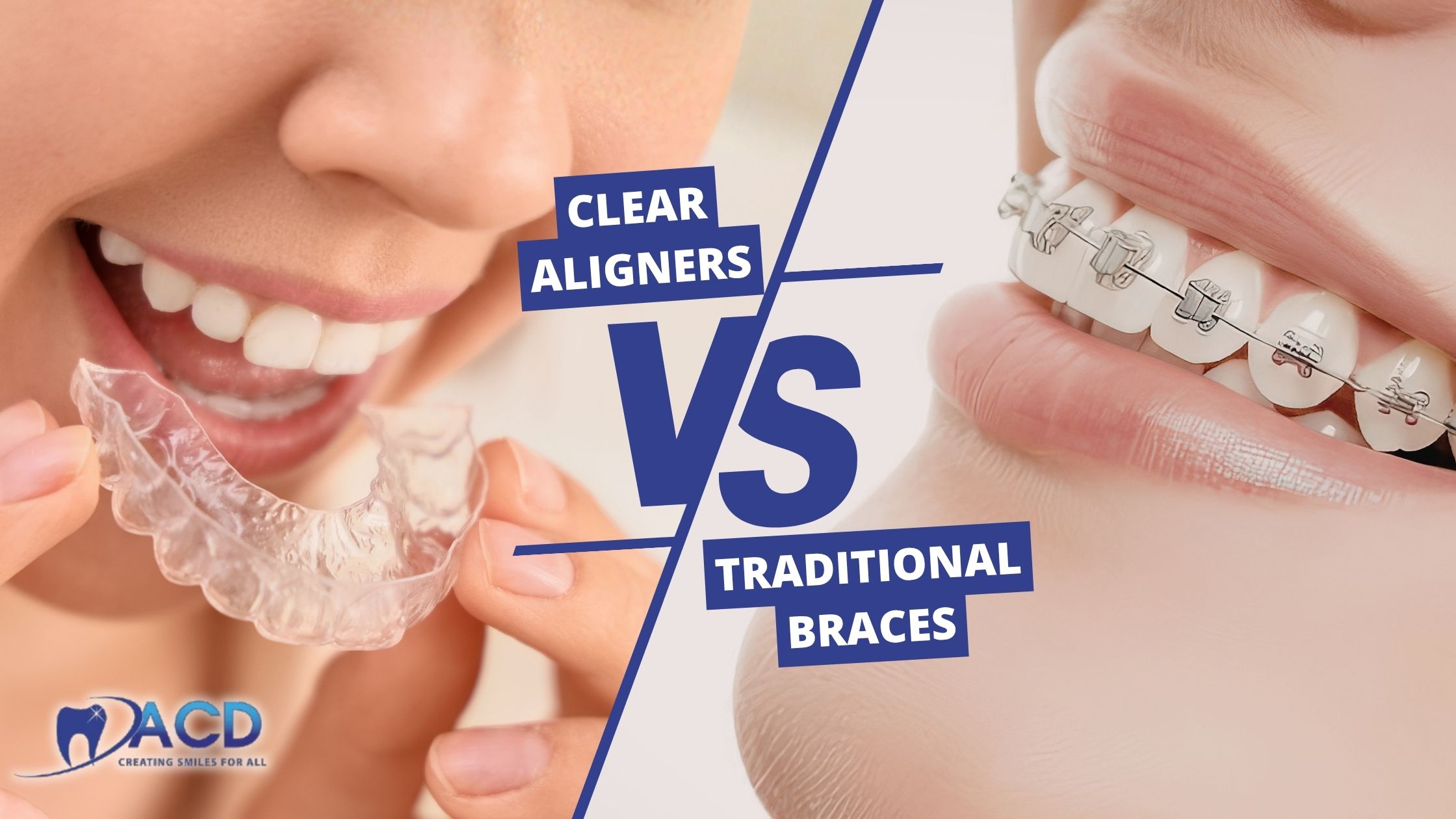
Adults seeking orthodontic treatment in Whitehall Township often face a fundamental decision: clear aligners or traditional braces. While both modalities are clinically effective, they differ in biomechanics, patient experience, cost structure, and case selection.
At Advanced & Comfort Dentistry, treatment planning is not based on preference alone. It is determined by diagnostic findings, periodontal status, occlusion, and long term stability goals.
This guide presents a clinically grounded comparison to help adults between 30 and 60 make an informed decision.
What Is the Core Difference Between Clear Aligners and Braces?
Clear aligners, such as ClearCorrect and CandidPro, use a sequence of removable, custom fabricated trays to deliver controlled force to teeth.
Traditional braces use fixed brackets bonded to teeth and connected by archwires to generate continuous mechanical force.
“Orthodontic treatment success depends not on the appliance itself, but on the precision of force application and biological response.”
Aligners rely heavily on patient compliance. Braces function continuously regardless of patient behavior.
Biomechanics and Tooth Movement
Orthodontic tooth movement is a biologic process involving bone remodeling and periodontal ligament adaptation.
Clear Aligners
- Deliver intermittent, controlled force
- Require 20 to 22 hours of daily wear
- Effective for planned, staged movements
- May require attachments for complex control
Braces
- Deliver continuous force
- More effective for complex rotations and vertical movements
- Provide greater control in severe malocclusion
For mild to moderate cases, aligners offer comparable outcomes. For complex skeletal or occlusal discrepancies, braces often provide superior mechanical control.
Aesthetic Considerations for Adults
For adults in professional or social environments, visibility is a major factor.
Clear Aligners
- Nearly invisible
- Minimal impact on speech after adaptation
- Preferred in patient facing professions
Braces
- Visible metal components
- Ceramic options reduce visibility but remain noticeable
For adults prioritizing discretion, aligners are typically favored.
Comfort and Daily Function
Clear Aligners
- Smooth surfaces reduce mucosal irritation
- Removable for eating and oral hygiene
- Temporary pressure during tray changes
Braces
- Brackets and wires may cause irritation
- Require dietary restrictions
- Periodic tightening may cause discomfort
Aligners offer greater day to day comfort, particularly for adults unaccustomed to orthodontic appliances.
Oral Hygiene and Maintenance
Oral hygiene becomes significantly more complex with fixed appliances.
Clear Aligners
- Removed for brushing and flossing
- Lower risk of plaque accumulation when compliant
Braces
- Increased plaque retention around brackets
- Higher risk of decalcification if hygiene is poor
Adults with a history of gum sensitivity or periodontal concerns often benefit from the hygiene flexibility aligners provide.
Alt text: schedule a free orthodontic consultation at Advanced & Comfort Dentistry in Whitehall, PA
Treatment Duration and Compliance
Treatment timelines vary based on case complexity and biological response.
Clear Aligners
- Average: 6 to 18 months
- Dependent on strict compliance
- Missed wear time delays progress
Braces
- Average: 12 to 24 months
- Less dependent on patient compliance
“In aligner therapy, compliance is a primary determinant of treatment success.”
Adults with unpredictable routines may need to realistically assess adherence before choosing aligners.
Cost Comparison in Whitehall Township, PA
In Pennsylvania, orthodontic costs vary based on complexity and duration.
Clear Aligners
- Approximate range: $3,000 to $5,500
Braces
- Approximate range: $3,000 to $7,500
Cost overlap is significant. Aligners are not always more expensive, especially for mild to moderate cases.
Factors influencing cost:
- Case complexity
- Treatment duration
- Number of adjustments or refinements
- Insurance contribution
Insurance Coverage Differences
Most dental insurance plans treat orthodontics as a separate benefit category.
- Coverage often includes a lifetime orthodontic maximum
- Some plans cover both braces and aligners equally
- Others may classify aligners under cosmetic or elective categories
While at Advanced & Comfort Dentistry:
- Major insurance plans are accepted
- Benefits are verified before treatment
- Out of pocket estimates are provided in advance
Understanding your insurance structure is critical before selecting a treatment modality.
Case Selection: When One Is Better Than the Other
Clear Aligners Are Ideal For:
- Mild to moderate crowding
- Spacing issues
- Relapse after prior orthodontics
- Adults prioritizing aesthetics
Braces Are Preferred For:
- Severe crowding or rotations
- Complex bite correction
- Significant vertical discrepancies
- Cases requiring maximum mechanical control
Accurate diagnosis determines suitability. Appliance choice should never precede clinical evaluation.
Adult Specific Considerations
Orthodontic treatment in adults requires additional clinical attention.
Adults often present with:
- Existing crowns or bridges
- Periodontal bone loss
- Occlusal wear
- History of dental restorations
Aligners may be advantageous in cases requiring controlled, conservative movement around existing restorations.
Braces may be necessary when structural correction outweighs aesthetic preference.
Risks and Limitations
Both systems carry potential risks when not properly managed.
Clear Aligners
- Non compliance leading to delayed results
- Tracking issues requiring refinements
Braces
- Increased plaque accumulation
- Higher risk of enamel decalcification
In both cases:
- Root resorption is a known but controlled risk
- Periodontal monitoring is essential
Clear Aligners vs Braces: Quick Comparison for Adults
Choosing between clear aligners and traditional braces depends on more than appearance alone. Adults should evaluate treatment complexity, lifestyle, comfort, maintenance, and long-term goals before deciding.
This quick comparison table highlights the most important differences to help simplify your decision.
| Comparison Area | Clear Aligners | Traditional Braces |
|---|---|---|
| Biomechanics & Tooth Movement | Controlled, removable trays for mild to moderate cases | Continuous fixed force for complex cases |
| Esthetic Considerations | Nearly invisible | Visible brackets and wires |
| Comfort & Daily Function | More comfortable, removable for eating | May cause irritation, dietary restrictions |
| Oral Hygiene & Maintenance | Easier brushing and flossing | More difficult cleaning, higher plaque risk |
| Treatment Duration & Compliance | Faster in some cases, requires discipline | Longer average time, less compliance-dependent |
| Cost Comparison in Whitehall | ~$3,000–$5,500 | ~$3,000–$7,500 |
| Insurance Coverage | Coverage varies by plan | More commonly covered |
| Risks & Limitations | Compliance issues, limited for severe cases | Hygiene challenges, enamel risk |
What Do Most Adults in Whitehall Township Choose?
In clinical practice, adults between 30 and 60 increasingly prefer clear aligners due to:
- Discreet appearance
- Flexibility in daily life
- Easier hygiene maintenance
However, preference does not override clinical necessity. The most appropriate treatment is determined after diagnostic evaluation.
Frequently Asked Questions
Are clear aligners faster than braces?
Not necessarily. Treatment speed depends on case complexity, tooth movement needs, and patient compliance. Aligners can match braces in mild to moderate cases, but braces may work faster for complex corrections.
Source: American Association of Orthodontists (AAO)
Do braces work better than aligners?
For severe crowding, bite correction, or complex movements, braces often provide greater control. For mild to moderate alignment issues, clear aligners can deliver comparable results.
Source: Proffit WR et al., Contemporary Orthodontics
https://www.elsevier.com/books/contemporary-orthodontics/proffit/978-0-323-54387-3
Can I switch from braces to clear aligners?
Yes, in some cases. Hybrid treatment may allow patients to transition from braces to aligners during later treatment stages, depending on clinical suitability.
Source: American Dental Association (ADA)
https://www.ada.org/
Is one more painful than the other?
Clear aligners generally cause less soft tissue irritation, while braces may lead to more bracket or wire related discomfort. Both can cause temporary pressure during tooth movement.
Source: BMC Oral Health Study
https://bmcoralhealth.biomedcentral.com/
Which is better for adults with dental work?
Adults with crowns, bridges, or mild periodontal concerns may benefit from aligners due to easier hygiene access, but treatment choice depends on full clinical evaluation.
Source: American Academy of Periodontology
Which Option Is Right for You?
There is no universal answer. The correct choice depends on:
- Clinical diagnosis
- Lifestyle and compliance
- Aesthetic priorities
- Financial considerations
At Advanced & Comfort Dentistry, we evaluate all these factors before recommending a treatment plan.
Schedule Your Free Orthodontic Consultation
If you are considering clear aligners or braces in Whitehall Township, Allentown, or surrounding areas, a clinical evaluation is the first step.
Your consultation includes:
- Digital scan
- Candidacy assessment
- Insurance verification
- Cost breakdown
- Personalized treatment plan
Clinical Disclaimer
This content is for educational purposes only and does not substitute a clinical examination. Treatment recommendations vary based on individual oral health, diagnostic findings, and compliance. In cases of severe infection or dental emergency, immediate care is required.